Monday, April 07, 2008

Porto 3: Port in a storm

[April 7, Porto]

The name of the fortified wine port comes from Porto. The process of making port was discovered somewhat accidentally, by the need to add brandy in order to stabilize wine for shipping long distance. The British found that the necessity was in fact a virtue and have loved port ever since. British names (Taylor, Croft, etc) still dominate the industry.


Sunday, April 06, 2008

Porto 2: On the waterfront

[April 6, Porto]

The most scenic part of Porto is the river "Ribeiera" district. It is the old working waterfront where from the 14th century flat-bottomed river boats brought wine and other goods were brought down the Douro to ship away. Once bustling, gritty, and commercial, it is now bustling, touristy, and commercial. And delightfully picturesque.


I have seen Porto, and it works

[April 6, Porto]


Porto is "the city that works", priding itself on a gritty and workmanlike attitude. The local saying is "Coimbra studies, Braga prays, Lisbon parties, and Porto works". Thus its attitude appeals to these two travelers from the working city of Houston . It also has a more "Atlantic" weather, and as you will see from some of the photos, rain and clouds are common.

Saturday, April 05, 2008

Coimbra album

[Coimbra, Portugal]

2008-PortSpain-03-Coimbra

How green is my soup

[April 5, Coimbra]

Little by little we are trying the Portuguese cuisine. It is not always a success. A few days ago Bettie had salted cod, and I had a curried chicken (the Goan connection, you know). The curry was instantly forgettable, and Bettie's cod was vividly memorable, but for the all wrong reasons.

But today we tried something worth repeating: Caldo Verde. a green soup of kale and potato puree. Fairly good in a soul-food sort of way. We also tried the local Coimbra pastry "pastel de Tentugal"; it made us long for Belem and pastel de nata.

Coimbra 3 -- The Dog Killers

[April 5, Coimbra}

Descending from the university we pass

the old cathedral, built while the Moors were still making nuisances of themselves in the neighborhood, looks (and is) a fortress.

Coimbra 2 -- The Gown

[April 5, Coimbra]

The University of Coimbra is atop a steep hill. Some walk; the wimps take the elevator, and enjoy

Coimbra 1 -- The Town

[April 5, Coimbra]


Today is a little cooler, and our itinerary takes us away from the noisy traffic into the ancient  parts of the city. Coimbra has been a university town for over 700 years, and before that it figured in the struggle between Moors and Christians, changing hands several times. With improving fortunes of the Christian reconquest, Coimbra became the capital of the first true kings of a united Portugal.

Friday, April 04, 2008

Coimbra is hot but the Guinness is cold

[April 4, Coimbra]

The train from Lisbon was efficient and pleasant, except for the seriously dirty window that inhibited seeing the countryside. Our first impression of Coimbra was not favorable. Our hotel (Ibis) is located on a busy street, and though Coimbra is smaller than Lisbon, it seems strangely hectic and stressful. The heat is stifling, and yet our hotelier has determined that it is not yet hot enough in the year to provide air conditioning; we disagree. We walked around for a bit to orient ourselves then staggered into an “Irish Pub” for some Guinness and a cheeseburger; this was no time for culinary experimentation.

Thursday, April 03, 2008

The Sintra Album

[Sintra, Portugal]

2008-PortSpain-02-Sintra

Sintra and castlemania

[April 3, Sintra]

Today we took a side trip to Sintra, about 30 minutes by train from Lisbon. Sintra was the get-away spot for Portugal's royals from 15th-19th centuries. (The royals themselves were gotten away with in the 20th century). There are two castle/palaces in Sintra, one very old and one less so, and each a marvel.  The interiors are filled with breathtaking azulejos and period furnishings. Regrettably, the modern day castellans forbid photography inside, so we can only offer these snaps of the exteriors.

The Lisbon album

Here is the complete Lisbon (and Belem) album

2008-PortSpain-01-Lisbon

Wednesday, April 02, 2008

Big Mac Arbitrage

[April 2, Lisbon]

So where is the beef?

A principle (observed somewhat approximately) of economics is "purchasing power parity". The idea is that after converting for foreign exchange rates, a given amount of money should buy the same amount of the same items, in all countries.

All tarted up

[April 2, Lisbon (Belem)]

Image:Pasteis.jpg
(Photo from wikipedia)

Not the voyages of Vasco da Gama, not the naval science of Henry the Navigator, not the discovery of Brazil. The signal achievement that ranks Portugal among the foremost of nations is ...

Lindbergh wasn't the first

[April 2, Lisbon (Belem)]

Lindbergh was not the first to cross the Atlantic in a plane.


Tuesday, April 01, 2008

Piles of tiles

[April 1, Lisbon]

We skipped the more famous and doubtlessly worthy Gulbekian art museum, and sought out things distinctive of Lisbon and Portugal. In the Alfama district, the Fundacao Ricardo do Espirito Santo Silva museum and the National Tile Museum showcase Portugal's ceramic tile art.

Castelo and Alfama

[April 1, Lisbon] 

Sao Jorge castle was built in the 8th century by the Moors, but then completely rebuilt by Salazar in the 20th century. It is not particularly attractive or impressive in itself,

Baixa

[April 1, Lisbon]

Today we walked the Baixa, the historic axis of Lisbon from Rossio square (pictured left) to the harbor. It is surprising how manageable the city is to the pedestrian, and how tame is the traffic. The noise in below threshold of pain, and the act of crossing streets is no more suicidal than in Houston. Such is not our experience with certain other Mediterranean capitals.

Monday, March 31, 2008

Day 1 & 2 -- Lisbon

[March 30 & 31, Lisbon]


Our arrival did not auger well. The chaos and disorganization of the Lisbon airport rivals that of Delhi's in 1990. Two hours waiting to get through immigration. Tired tourists uniting to resist pushy Nigerians trying to break in line. Lots of fun.

Beginning Tayara Travels

Here we undertake a blog to document our travels, in near real time. We'll begin with the present trip (Portugal & Spain), and perhaps in the future we will back-fill previous trips.

We'll try to update the blog as the our trip proceeds, time and Internet connections permitting.

Saturday, October 01, 2005

Older stuff on this blog

I began this blog during a trip to Easter Europe in 2005 and abandoned it for technical reasons. I'm keeping the few posts from that trip for reference.

Tuesday, September 13, 2005

Promenades and Comrades


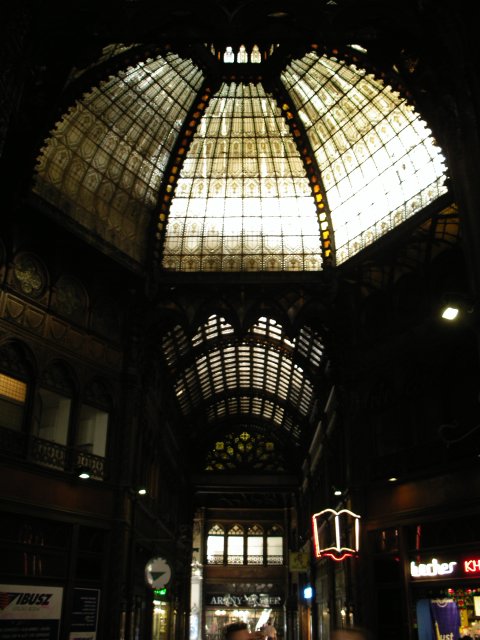
On our first full day we took it easy and got the feel of the city by walking around. Much of present day Budapest dates from late 19th/early 20th century, and there are fine Art Nouveau buildings in varying degree of repair and serviceability. A particularly fine turn-of-the-century shopping arcade is just now being restored and returned to life.


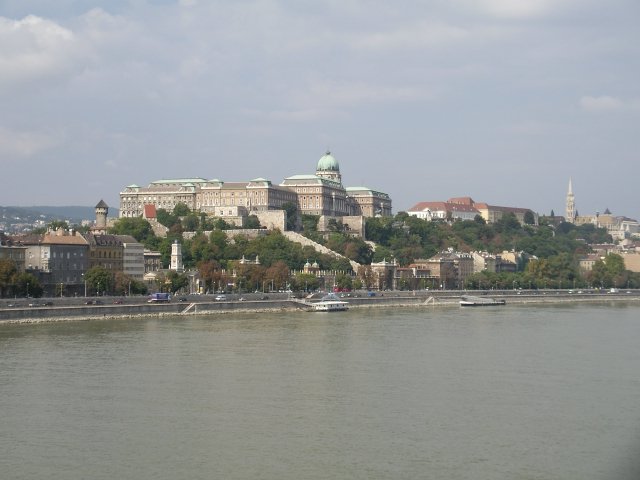
Danube Embankment, looking towards Buda
Down to the Danube Embankment, our first view of this river of legend. The Embankment makes a fine promenade with international hotels, sidewalk cafes, gardens, and views of Buda castle across the river.


IMGP0249
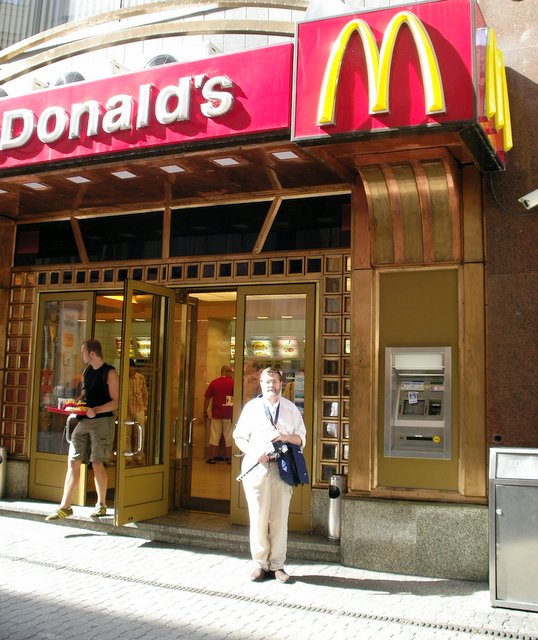
Downtown is pierced by long and pleasant pedestrian ways that host upscale tourist shops, gelato stands, and restaurants. There is a pleasing mixture of the traditional and the modern. Though a tourist promenade today, the area has hidden historical significance. This street, Vaci Utca, was a showcase of western luxury goods when Hungary was the most advanced and liberal of the Iron Curtain countries. Good communists came from all over the Soviet sphere to drool over the decadent spoils of capitalism. Even the Golden Arches had significance in those days, being the only McDonald's behind the Iron Curtain. Eating a Big Mac was an act of defiance, a political statement giving real meaning to "freedom fries". Today McDonald's gives its nod to Eurotastes with an adjoining "McCafe".


IMGP0253
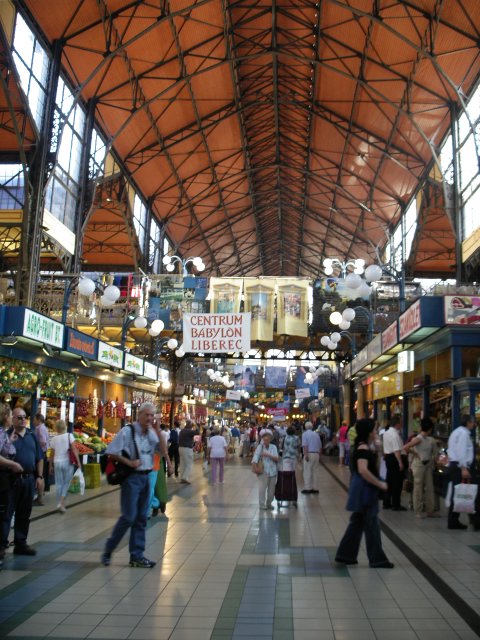
Another landmark in the area is the Great Market, a free-market hall surviving the depredations of two world wars and central planning. In 1989 Margaret Thatcher gave a historic address on its steps, heralding the coming of the open society. Little did any know how soon it would come.


IMGP0254
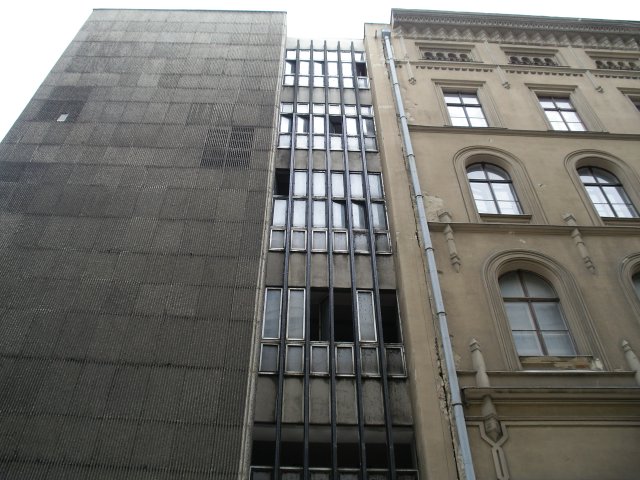
We were pleased to find not all traces of the people's collectivist paradise erased. There are many exemplary buildings built by the Communists still (barely) standing in downtown Budapest. Some are in progress demolition, but enough remain to provide instructive contrasts.

View more photos from Budapest

Monday, September 12, 2005

Arrival in Budapest

We flew KLM from Houston to Amsterdam, and Air Malev (KLM partner) to Budapest. The flight was as comfortable as 13 hours in coach can be, and completed without remark.

Our first contact with Budapest was quite favorable. The airport is comfortingly modern, efficient, and secure.
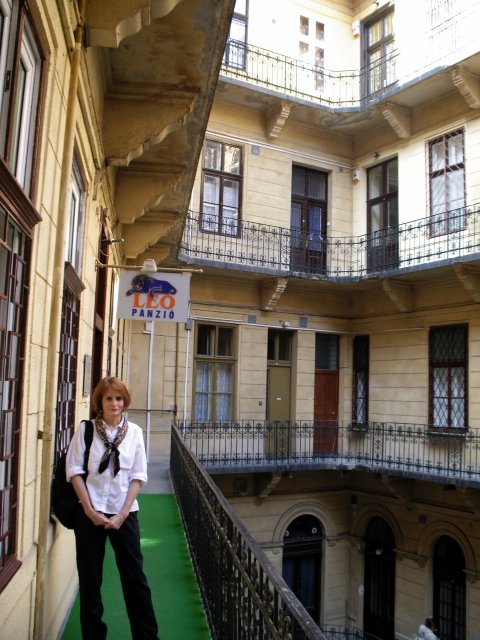
A polite taxi driver dropped us at our hotel, the Leo Panzio, centrally located on the Pest side of the Danube. Fairly modern rooms situated in an old building. The rickety open-cage elevator welcomes the guest on entry with a loud crack and a jolting drop of an inch, a most satisfying frisson.

We celebrated arrival in a nearby restaurant/beer-hall with cream of asparagus soup, gundel pancakes, cottage cheese dumplings, and Austrian beer. On leaving the restaurant we were arrested by an elderly Hungarian lady, well and expensively dressed, who informed us that her family had at one time owned most of the commercial buildings along the street. She claimed current residence in Miami and Palm Springs, and assured us (repeatedly) that she was a "lady of means". Not releasing us, she commandeered a prominent table in the restaurant and proceeded to write out with painfully slow but clear script the particulars of her life, addresses, personal references, and friends in the United States. She seemed to be urgently trying to establish her place and her significance. Why this Magyar ancient mariner latched onto two jet-lagged travelers to hear her tale was never explained. Perhaps a local "character", a victim of terminal nostalgia bordering on dementia. We extricated ourselves with difficulty and left, she to her memories and we with our first mystery of the east.

Saturday, September 10, 2005

Why Eastern Europe?

People often ask us with apparent puzzlement, "Why did you choose ___?" where ___ is the destination of our vacation in any given year. That is somewhat like the archetypal Jewish mother who gives her son two neckties for his birthday. When he puts on the first one, she asks in a voice of practiced suffering, "You didn't like the other one?" There are many countries, and we have but one vacation a year. So choices must be made. And this year, it is Eastern Europe.

It seems a good time to go. More than a decade after the fall of the Iron Curtain -- time enough for hotels, cuisine, and travel services to reflect the values of the free world, but not time enough for the former Soviet "clients" to become homogenized into Euroculture. We hoped to find still a whiff of the exotic, the forbidden, a distant echo of Graham Greene or le Carre. But washed down with good Austrian beer and well served by T-Mobile.